31st January 2017
Dosed up with tablets, I rattled down to an early breakfast. Feeling ok, I managed some cereal and two slices of toast, washed down with a small glass of mango juice. I crossed my fingers that I wouldn’t be seeing them again, but thanks to the powers of modern chemistry, I needn’t have worried; the valve was well and truly closed.
As a group, we set off on foot towards the river, passing a large enclosure where numerous elephants stood with their mahouts astride, patiently waiting for customers. At the riverbank, around half a dozen dugout canoes, each carved from the trunk of a large tree, were being loaded, several by groups of Chinese tourists. Our canoe held 14 of us, plus a guide and steerer, all seated in a line on low wooden benches resting at the bottom of the craft. Fully loaded, the waterline was just a hand span away from spilling over the sides.


I had the advantage of the guide sitting just behind me, providing a running commentary on the passing flora and fauna as we gently drifted down the river. A few crocodiles lay dormant on the riverbank, but most were in the water, with only their eyes peeping out hopefully.
“The water is too cold at this time of morning for the crocodiles to feed,” the guide reassured us.
When I dipped my hand into the water, it felt as warm as bathwater. I could only hope he was right, and that crocodiles don’t get frisky until the water’s nearly boiling!


We passed water buffalo enjoying their morning dip and spotted tourist-laden elephants meandering along the riverbank, weaving in and out of the trees. The branches seemed to be teeming with birds bearing exotic names. I’m afraid the only ones I remember are hornbills, mainly because they look so comical in flight. The rest either moved too quickly or not at all, and none left a lasting impression beyond their bright, dazzling colours.
Sue has a much keener interest in such things, and I’m quite happy to leave that side of the marriage to her.
All too soon, we had to disembark from our steady little craft and step onto the crocodile-infested shore.


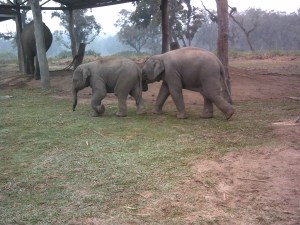
After a short walk, we arrived at the elephant breeding station. It’s part of a government initiative to sustain the population of tourist elephants without having to take them from the wild. A sensible solution, I suppose, though I have mixed feelings.
The breeding elephants were tethered by one foot to a stake, while their young were free to roam and play, which they did, as all youngsters do. It seemed hard on the mothers. Each day at 11 am, the elephants are taken into the jungle by three mahouts per animal for three hours to feed and exercise. It sounds more like a prison sentence than a routine, but who am I to judge?

We returned to the hotel by way of a rickety wooden and sandbag bridge over the river, followed by a short drive in a Land Rover. After lunch, Sue took a brief nap while I caught up with yesterday’s blog.
At 3 pm, some of the group had arranged to go elephant riding. I, however, had negotiated with the rangers for a walking safari after the riders had set off on their steeds. After watching them nervously mount their elephants, I set off with two rangers, crossing the river in one of the canoes.
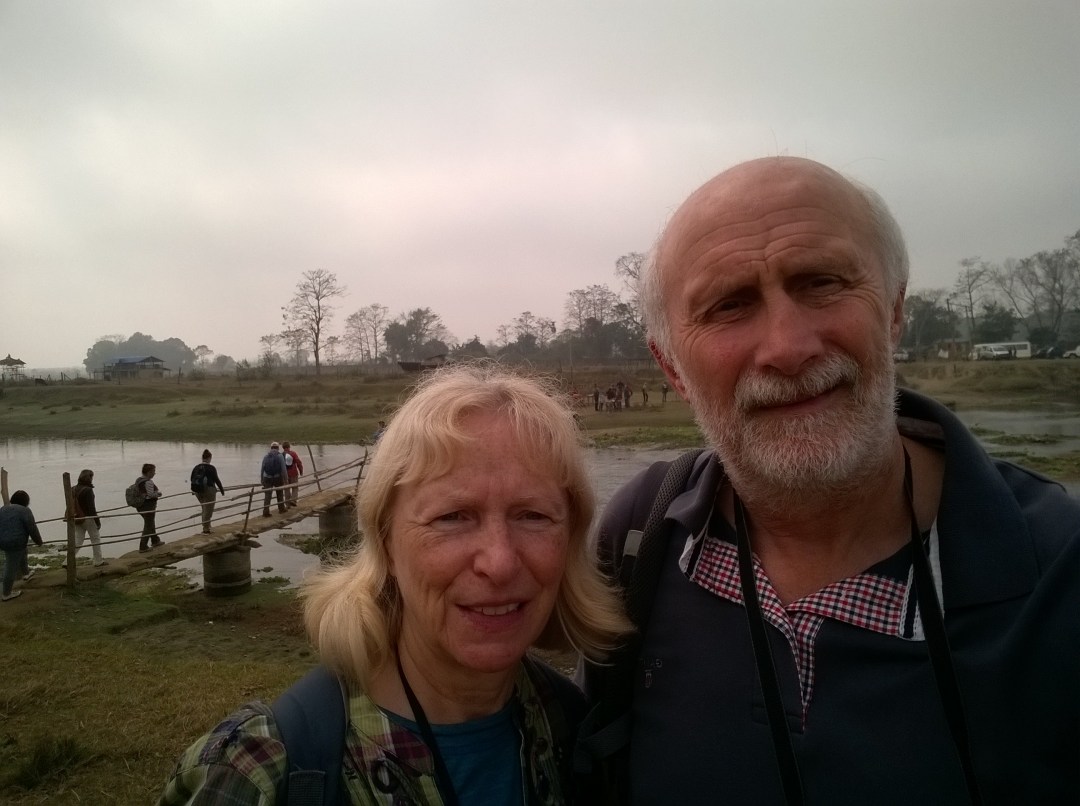
My guides were incredibly knowledgeable about all things Nepalese, though their expertise particularly shone when it came to birds. I learned a few more names, bobo, fish eagle, and others. I had meant to provide a longer list, having made a concerted effort to remember them, but most have slipped my mind. With Sue back at the hotel, reading by the pool, I can’t even consult her for reference.
We carefully approached several beached crocodiles so I could photograph them, but sensing my guide’s nervousness, I decided not to get too close. I imagine the paperwork would have been horrendous if I’d been eaten. Then I recalled that Sue and I had read in the ‘Kathmandu Times’ earlier this week that six people had been killed by animals in this park over the past six months, mostly by rhinos with young. Close call!

And then, of course, we came across a rhino with its calf. Fortunately, they were feeding in the river with their backs to us. We retreated gracefully into the jungle, and I had no desire to play the daring tourist in pursuit of a closer photo. You won’t find such a helpful news item in the British press from me today.
We spotted plenty of monkeys, water buffalo, more birds, some tiger scratches on tree trunks, lots of unknown birds, and a couple of cranes.
We returned to our starting point near the elephant ‘lift-off’ station via another canoe, hitched by my guides on a passing boat heading home. With some time to kill before the elephant riders lumbered back, I watched a troupe of Rhesus monkeys foraging around a pile of freshly laid elephant dung. I can only hope they washed their hands afterwards, you can pick up some nasty bugs in this country!

Early in the evening, our group boarded a couple of Land Rovers and drove into town to watch some authentic Nepalese dancing. We were told their speciality was the Peacock Dance. We arrived first and managed to secure front-row seats, with the Chinese tourists arriving next and swarming the place, taking selfies at every opportunity.
The theatre gradually filled up, and the show began. It wasn’t particularly colourful, nor was it brilliantly choreographed. It would have helped if all the dancers had the proper equipment, rather than having to pretend they were holding it. But then, this is a third-world country that was nearly knocked back into the Stone Age just two years ago, so I can forgive them for cobbling together some routines and having the courage to perform them for foreigners.
The repeated power failures we’ve experienced this week serve as an ever-present reminder of how fragile their recovery is.
And the Peacock Dance? Yes, it was enjoyable and amusing, so what’s not to like?


On returning to the hotel, we had our evening meal and then retired to our rooms for yet another early start the following morning… down that same darn road!


Leave a comment